Q-bital Healthcare Solutions Ltd is committed to achieving Net Zero emissions (when all greenhouse gas (GHG) emissions produced by the business will be equal to or less than the emissions removed from the environment) at the latest by 2045. An earlier date of Net Zero emissions by 2040 has been set as a stretch target.
Reducing our GHG emissions brings significant benefits for us, our customers, suppliers and the wider community. Achieving Net Zero is also a legal requirement in the UK by 2050 according to the provisions of the Climate Change Act 2008.
Baseline emissions are the reference point against which current or future emissions are measured. A baseline helps us evaluate our carbon performance and the effectiveness of reduction initiatives by allowing a comparison between a starting position and the actual situation after interventions.
In measuring energy use and calculating GHG emissions, Q-bital adopted the principles of the GHG Protocol Corporate Standard, including the operational control method. The company began collating a quantified carbon footprint for the 2021 baseline year with support from an independent specialist, Carbon Manager, Bath, UK. This 2021 baseline assessment was an initial carbon footprint exercise rather than a full organisational audit; Q-bital screened and reported against the data available at the time, including 7 of the 15 Scope 3 categories, with the intention of broadening the scope and improving the accuracy of data collection and emissions calculations in subsequent reporting years.
| Baseline Year: 2021 (Jan to Dec) |
|
| SCOPE TYPE | TOTAL EMISSIONS (metric tonnes (t) of CO2e1) |
| Scope 1 (direct) | 17 |
| Scope 2 (indirect) | 97 |
| Scope 3 (indirect) Included categories: Categ. 1: Purchased Goods & Services Categ. 3: Fuel & Energy Related Activities Categ. 5: Waste Generated in Operations Categ. 6: Business Travel Categ. 7: Employee Commuting Categ. 9: Downstream Transportation & Distribution |
65982 8 65 205 148 151 |
| Total emissions | 773 |
1 Carbon dioxide equivalent: in-line with best practice, Q-bital calculates CO2e, a standard unit of measurement to express different GHGs (e.g. methane, nitrous oxide) on a common basis by conversion according to their global warming potential relative to CO2.
| Reporting year: 2025 (Jan to Dec) | |
| Emissions | Total (tCO2e) |
| Scope 1 | 140 |
| Scope 2 (location-based) Scope 2 (market-based) |
182 35 |
| Scope 3 (indirect) Included Categories: Categ. 1: Purchased Goods & Services Categ. 2: Capital Goods Categ. 3: Fuel & Energy Related Activities Categ. 5: Waste Generated in Operations Categ. 6: Business Travel Categ. 7: Employee Commuting |
5,1893,327 1,120 462 23 2 153 117 |
| TOTAL EMISSIONS (using Scope 2 location-based) TOTAL EMISSIONS (using Scope 2 market-based) |
5,437 5,364 |
Total emissions have increased since base year due to growth in business activities and improved accuracy of calculations:
| | Base Year 2021 | Reporting Year 2025 |
| Revenue £'m | £55.4m | £50.9 |
| Number of business premises | 3 | 4 |
| No of employees | 102 | 88 |
| No of mobile/modular facilities | 63 | 78 |
| | | |
| Absolute GHG emissions' totals | | |
| Scope 1 | 17 | 140 |
| Scope 2 | 97 | 108 |
| Scope 3 | 659 | 5,189 |
| Total Scopes 1, 2 & 3 | 773 | 5,437 |
| | | |
| Carbon intensity | | |
| Scopes 1 & 2 tCO2e per £1m revenue | 2.06 | 4.87 |
| Scopes 1, 2 & 3 tCO2e per £1m | 13.95 | 106.82 |
| Scopes 1 & 2 tCO2e per employee | 1.12 | 2.82 |
| Scopes 1, 2 & 3 tCO2e per employee | 7.58 | 61.78 |
| Notes: Scope 3 emissions have materially increased since 2021 as our approach and data capture techniques improved since the base year. | Limited Scope 3 categories |
Significantly improved coverage of Scope 3 categories |
For comparability with the baseline, the headline totals and intensity metrics use location-based Scope 2 emissions unless stated otherwise. Note: the 2021 baseline and 2025 reporting year are not directly comparable on a like-for-like basis as Scope 3 category coverage has expanded from 7 to 12 categories. The apparent increase in absolute emissions and intensity metrics since 2021 substantially reflects this expanded scope rather than operational deterioration alone.
T help us to realise our commitment to achieving Net Zero emissions by 2045, we have adopted the following carbon reduction targets:
Emissions “under the control of the business” comprise Scope 1 and Scope 2 emissions together with those Scope 3 emissions arising directly from Vanguard’s own operational decisions and activities. Emissions that the business can only influence relate primarily to wider value-chain activities within Scope 3, including purchased goods and services, capital goods, transport and distribution, and other supplier-related emissions. While Q-bital does not have direct operational control over these activities, we recognise our responsibility to work collaboratively with suppliers, customers and other stakeholders to reduce associated emissions. Interim and long-term targets are measured against the 2021 baseline year and are intended to be achieved by the end of the stated target year.
Carbon reductions in relation to activities in each of the three scopes will continue to be discussed, investigated and progressed by Q-bital.
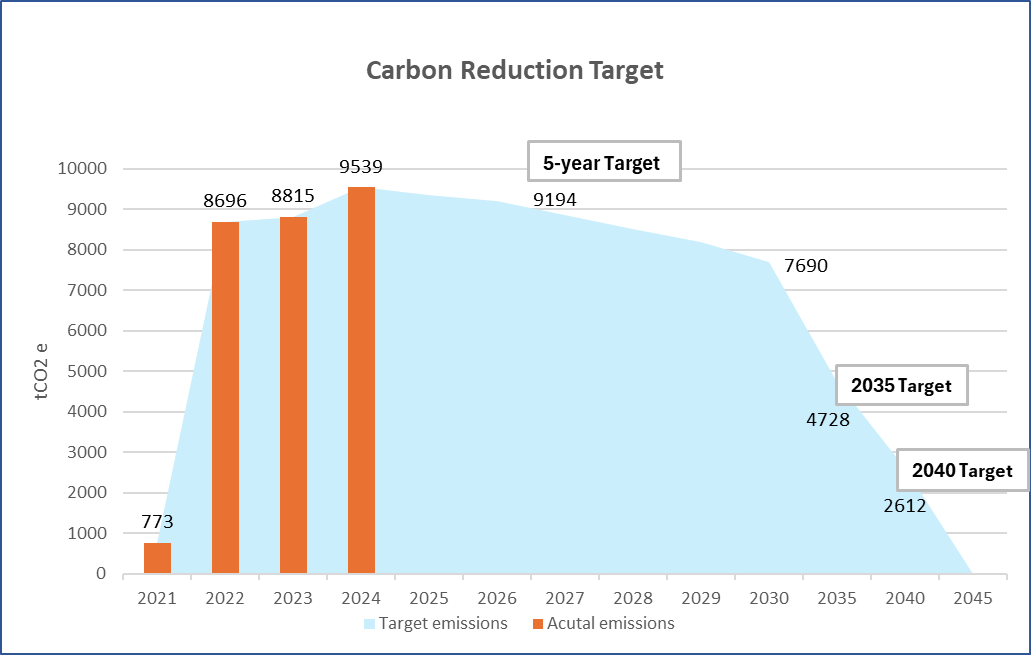
The reduction in 2025 Scope 1 and 2 (location-based) emissions compared with the previous year was driven principally by a reduced operational footprint, improved use of actual supplier data in specific areas, and updated emissions factors.
The following environmental management measures and projects have been completed or implemented since the 2021 baseline:
Our carbon reduction goals are approved and supported by the senior management team and the board of directors.
In developing our strategy, we aim to deliver gradual but continuous improvements in our performance each year by implementing complementary measures such as:
In 2023 and 2024, Q-bital partnered with Klimate (www.klimate.co) who provide access to high-quality, innovative and verifiable engineered and nature-based carbon removal schemes to remove GHG emissions from the atmosphere.
The table below outlines the Scope 1 and 2 emissions since base year (2021), carbon removals procured and the overall net balance as at 31st December 2025:
| Year | Scope 1 & 2 Emissions (t CO2e) |
| 2021 (Base) | 114 t |
| 2022 | 195 t |
| 2023 | 191 t |
| 2024 | 259 t |
| 2025 | 248 t |
| TOTAL | 1,007 t |
| Carbon Removals | (950 t) |
| Net Balance Remaining | 57 t |
Our strategy for carbon removals has evolved as our carbon maturity has increased.
The experience working with Klimate has informed our current approach:
Purchased carbon removal credits are disclosed separately from gross emissions reductions and are not counted per se towards Vanguard’s operational decarbonisation progress. Cred-its are only considered to contribute to a “net” position once independently verified and for-mally retired. The cumulative 950 tCO₂e of removals procured to date offsets approximately 94% of cumulative Scope 1 and 2 emissions (from 2021 to 2025). This is presented as a “net balance” rather than evidence of operational decarbonisation.
Graham Rich
Chief Executive Officer
Q-bital Healthcare Solutions Ltd
June 2026
2 https://ghgprotocol.org/corporate-standard
3 https://www.gov.uk/government/collections/government-conversion-factors-for-company-reporting
4 https://ghgprotocol.org/standards/scope-3-standard
Q-bital Healthcare Solutions
Unit 1144 Regent Court, The Square, Gloucester Business Park, Gloucester, GL3 4AD